Tanzania Startup Week 2025: An Investor’s Perspective
Introduction: Karibu TSW 2025!
In last month’s post, we visited Lagos, Nigeria to cover the African Business Angels Network (ABAN) Congress 2025. In this month’s post, we go to Dar es Salaam, Tanzania, to cover the Tanzania Startup Week 2025 (TSW) events, hosted by the Tanzanian Startup Association and cosponsored by the Coprosperity Fund.
“Tanzania Startup Week 2025 (TSW 2025) is the country’s largest startup ecosystem platform,” according to its organizers, “an annual, high-energy gathering of innovators, investors, policymakers, and partners united to accelerate Tanzania’s future. Co-created as an open platform with a shared agenda and outcomes, TSW showcases high-potential startups, drives policy breakthroughs, and forges new investment commitments all aligned with Tanzania’s Vision 2050 ambition.”
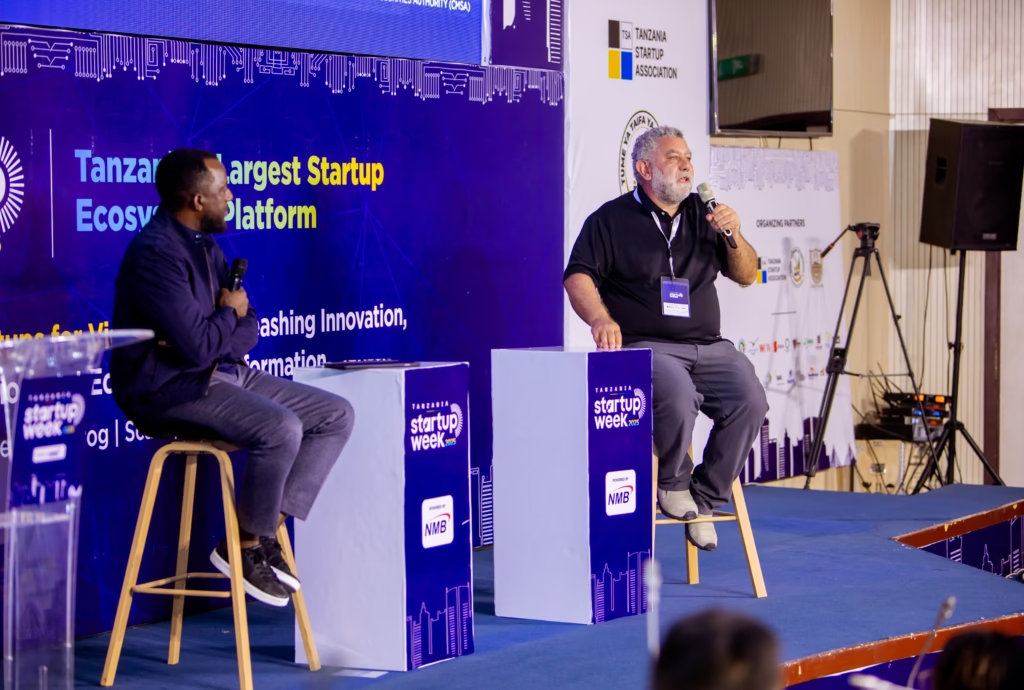
The Managing Partner of the Coprosprity Fund, Antony Adolf, was invited to speak as a panelist on the second day of TSW 2025. The Coprosperity Fund’s new Marketing and Communications Manager, Link Mkwawa, attended the conference as the Fund’s representative. Taken together, their participation and contributions underscores the Coprosperity Fund’s commitment to Tanzania’s startup ecosystem.
The purpose of this post is to highlight salient parts of their experience as an investor-sponsor of TSW 2025 that have a wider impact on both funders and founders in Tanzania and the East African Community.
So as they say in Swahili, “Karibu” or “Welcome” to Tanzania Startup Week 2025!
Innovation Meets Opportunity: TSW 2025 Begins
Dar es Salaam is Tanzania’s economic center, bringing together both big and small businesses in a sprawling seashore hub. This week the city hosts Tanzania Startup Week 2025 at the Millenium Towers, an aptly named venue for the series of events where “innovation meets opportunity, a catalyst positioning Tanzanian startups to innovate, leapfrog, scale, compete, and globalize.”
The opening remarks were given by Zahoro Muhaji the CEO of the Tanzania Startup Association, Anabahati Mlay, the Co-Chairperson of Tanzania Startup Week 2025 and Paul Makanza, the Chairperson of the TSA Board. Collectively, they highlighted how the week’s events are intended to galvanize ecosystem participants towards becoming catalysts for the Vision 2050 directive of a $1 Trillion Tanzanian economy.
The day’s speakers focus on the best way to empower startups towards accomplishing the Tanzanian vision 2050 while growing themselves, targeting the redefinition of policy and “Enabling Ecosystems for Sustainable Economic Growth.” The discussions also focused on the best ways to exploit the roles of financial innovations in the private sector and strategic partnerships, including venture capital and government funding.
Our Time to Shine: The Coprosperity Fund at TSW 2025
The Coprosperity Fund-sponsored panel is held on the morning of day two of the conference. The session’s title is “From Pre-Seed to Series A: Exploring Venture Capital and Alternative Financing Models for Tanzania’s Emerging Startups.” This session is intended to examine how Tanzania can build a coherent early-stage investment pipeline, leveraging venture capital, angel networks, corporate funds, and blended finance to catalyze high-growth enterprises capable of driving national and regional competitiveness.
Access to capital remains one of the most critical constraints in Tanzania’s startup ecosystem. Despite rising momentum, early-stage ventures face systemic financing gaps that hinder scale and sustainability. Across Africa, venture capital is expanding toward frontier markets, creating new opportunities for countries with strong policy alignment, credible deal flow, and investor-ready startups. Tanzania’s ecosystem is positioned to attract regional and global capital. However, scaling this potential requires a structured financing continuum that bridges pre-seed to Series A, strengthens governance, and enhances investor confidence.
Antony Adolf noted the difficulties in securing third-party capital in Tanzania due to the current regulatory environment. He introduced the Fund by noting its investment philosophy of “returns and relationships” with its goal of “three to five times growth in three to five years.” When asked what advice he would give to startups seeking angel investor funding, he was clear: “Never give up” and “Don’t be annoying.” He also highlighted the Coprosperity Fund’s upcoming Zanzibar Business Plan Competition, the first of its kind, to be launched in mid-January of 2026.
Conversations Continue: The Final Days
Among the most interesting panel discussions and conversations, for Linda Mkwawa, were on day three of the TSW 2025, including “Driving Tanzania’s Digital Transformation: Health, Cities and the Economy.” The panel discussions revolved around how healthtech can transform lives through digitization to ensure growth in the health sector and drive innovation in various health and care services.
The discussions were not only about insights and opportunities but also challenges faced in the current era. Some of the key speakers were from MUHAS and The Benjamin Mkapa Foundation, to name a few. It is important to note that, as a whole, the emphasis of TSW was on digital and tech businesses, not traditional businesses. This is a doubled-edged sword because many of the small businesses driving the Tanzanian economy are traditional businesses even if digital/tech ones attract more attention.
On the same day, other panel discussions were on “The Role of Connectivity and Infrastructure in Driving the Digital Economy.” The key speakers were engineers from WINGU group, Minara and Dinfotel. Again, it is the belief of the Coprosperity Fund that traditional businesses must be supported as we as digital/tech ones in order to reach Vision 2050 goals, something TSW 2025 largely overlooked.
Conclusion: The Tanzanian Startup Ecosystem Reawakens
Overall, from an investor’s perspective, Tanzania Startup Week 2025 was a great success. It brought together businesses, investors and policymakers into a single forum to discuss pressing issues about how to grow the national startup ecosystem.
While the presentations and panel discussions were on the whole excellent, there were no question-and-answer periods after each session and little or no audience participation in the discussions. Audience members included founders and funders who could have provided valuable insights into the vital topics discussed. This is something the organizers can work on for next year.
Many commentators have noted a decline of the Tanzanian startup ecosystem in recent years. However, if TSW 2025 is any indication, the coming years should see a reawakening as founders, funders and policymakers work together to grow the ecosystem as a whole, one small business at a time.