
The Hidden Reasons Why Small Businesses Fail — And How to Avoid Them
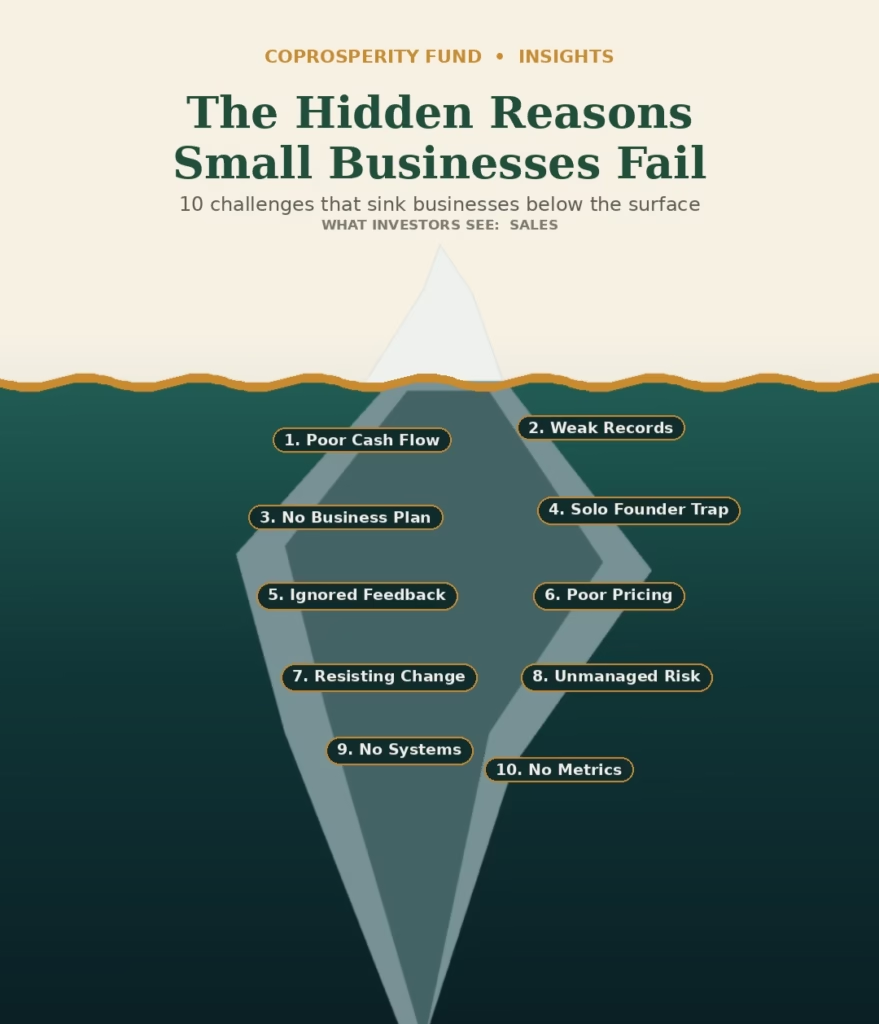
Every year, thousands of small businesses are started with enthusiasm, determination, and high expectations. Across Tanzania, entrepreneurs invest their savings, dedicate long hours, and work tirelessly to build businesses that can support their families and contribute to economic growth.
Yet despite their hard work, many of these businesses struggle to survive beyond the first few years.
It is easy to assume that businesses fail simply because they lack capital. While access to finance is certainly important, experience shows that money alone rarely determines whether a business succeeds or fails. In fact, many businesses receive funding but still struggle, while others grow steadily with limited capital because they build strong foundations from the beginning.
The reality is that business failure is often caused by a combination of hidden challenges that develop gradually over time. Most of these challenges are preventable when business owners recognize them early and take practical action.
This article explores some of the most common yet overlooked reasons why small businesses fail and provides practical suggestions that entrepreneurs can begin applying immediately.
1. Poor Cash Flow Management
One of the biggest misconceptions among business owners is believing that making sales automatically means the business is financially healthy.
Imagine a hardware store that records strong monthly sales. On paper, the business appears to be doing well. However, most customers buy on credit while suppliers require immediate payment. At the end of the month, the owner has impressive sales figures but very little cash available to pay rent, salaries, or restock inventory.
The business is profitable, but it runs out of cash.
This situation is more common than many entrepreneurs realize.
Cash flow is the movement of money into and out of a business. Without healthy cash flow, even profitable businesses can face serious financial difficulties.
What you can do:
- Monitor cash coming in and going out every week.
- Prepare a simple monthly cash flow forecast.
- Follow up outstanding customer payments promptly.
- Avoid unnecessary expenses during periods of low cash availability.
Key takeaway:
- Profit keeps a business attractive, but cash keeps it operating.
2. Weak Financial Record Keeping
Many entrepreneurs know their businesses very well—but surprisingly, they do not know their numbers.
Ask yourself this question:
Can you confidently state how much profit your business made last month?
If the answer is uncertain, there is an opportunity to strengthen your financial management.
Some business owners rely entirely on memory to track sales and expenses. Others mix personal and business finances, making it difficult to understand the true performance of the business.
Without reliable financial records, important decisions become guesswork.
Simple records help business owners answer important questions such as:
- Is the business making a profit?
- Which products generate the highest income?
- Which expenses are increasing?
- Is the business growing or declining?
The good news is that financial record keeping does not have to be complicated. A spreadsheet, accounting software, or even a well-organized notebook can make a significant difference.
What you can do:
- Record every sale and every expense.
- Separate personal and business transactions.
- Review your financial records at least once every month.
- Compare your actual performance against your budget.
Key takeaway:
- Good decisions are built on accurate information—not assumptions.
3. Lack of Business Planning
Many businesses begin with excitement and energy, but very few start with a clear plan.
Having a great product or service is important, but sustainable growth requires direction.
A business plan is not simply a document prepared to obtain funding. It is a roadmap that helps business owners understand where they are today, where they want to go, and how they intend to get there.
Businesses without a plan often experience:
- Unclear priorities.
- Inconsistent decision-making.
- Poor resource allocation.
- Difficulty measuring progress.
Planning also helps entrepreneurs prepare for unexpected challenges rather than reacting to them after they occur.
What you can do:
- Set clear business goals for the next 12 months.
- Prepare a realistic budget.
- Review your progress regularly.
- Adjust your strategy when circumstances change.
Key takeaway:
- Businesses rarely grow by chance—they grow through intentional planning.
4. Trying to Do Everything Alone
Many entrepreneurs wear multiple hats.
They are the manager, accountant, salesperson, marketer, customer service representative, and sometimes even the delivery driver.
While this approach may work during the early stages, it eventually becomes one of the biggest obstacles to growth.
When every important decision depends on one person, the business becomes dependent on the owner rather than operating as an independent organization.
This often results in delayed decisions, burnout, inconsistent customer service, and missed opportunities.
Growing businesses gradually shift from relying on people to relying on systems.
That does not necessarily mean hiring a large team. It means documenting processes, delegating appropriate responsibilities, and using simple tools that improve efficiency.
What you can do:
- Identify repetitive tasks that can be standardized.
- Document simple operating procedures.
- Use digital tools to organize daily activities.
- Delegate routine work where appropriate.
Key takeaway:
- A business should be able to operate efficiently even when the owner is not involved in every small task.
5. Ignoring Customer Feedback
Customers are one of the most valuable sources of business improvement.
Unfortunately, many businesses only communicate with customers when making a sale.
Successful businesses continue listening long after the transaction has been completed.
Customer complaints should not always be viewed as problems—they often reveal opportunities to improve products, services, or internal processes.
Businesses that ignore customer feedback risk losing loyal customers without understanding why.
Simple questions such as:
“How was your experience?”
“What could we improve?”
can provide insights that no financial report can reveal.
What you can do:
- Regularly ask customers for feedback.
- Respond professionally to complaints.
- Identify recurring concerns.
- Use customer suggestions to improve products and services.
Key takeaway:
- Businesses grow when they listen as carefully as they sell.
6. Poor Pricing Decisions
Pricing is one of the most important decisions a business owner makes, yet it is often one of the least understood.
Many small businesses set prices by simply copying competitors or charging what they believe customers are willing to pay. Others deliberately keep prices very low in the hope of attracting more customers.
While this may increase sales in the short term, it does not always lead to a healthy business.
For example, imagine a small furniture workshop that sells every product below its actual cost because the owner has not calculated labour, transport, electricity, and other operating expenses. Orders continue coming in, but profits never seem to grow. The business owner works harder each month without seeing financial progress.
Good pricing is not about being the cheapest. It is about understanding the true cost of delivering your product or service while creating value for your customers.
What you can do:
- Calculate all direct and indirect costs before setting prices.
- Review your prices regularly as costs change.
- Understand the value your product or service provides instead of competing on price alone.
- Monitor profit margins, not just sales volume.
Key takeaway:
- A growing business is not measured by how much it sells, but by how much value it creates and retains.
7. Failing to Adapt to Change
Markets never remain the same.
Customer preferences change.
Technology evolves.
Competition increases.
Economic conditions shift.
Businesses that refuse to adapt often struggle, even if they were once successful.
The COVID-19 pandemic demonstrated this reality. Many businesses that quickly adopted digital payments, online marketing, delivery services, and social media communication were able to continue serving customers despite significant disruptions.
Others waited too long to adjust.
Successful entrepreneurs continuously ask:
“What has changed?”
“What do our customers need today?”
“How can we serve them better?”
Businesses that continue learning are more likely to continue growing.
What you can do:
- Stay informed about industry trends.
- Listen carefully to changing customer needs.
- Be willing to improve products, services, and business processes.
- View change as an opportunity rather than a threat.
Key takeaway:
- Businesses that learn quickly are often the ones that grow sustainably.
8. Ignoring Business Risks
Every business faces uncertainty.
Unexpected expenses.
Delayed customer payments.
Supply shortages.
Regulatory changes.
Equipment breakdowns.
Many entrepreneurs only think about these risks after they happen.
Successful businesses prepare before challenges arise.
Risk management does not eliminate uncertainty, but it helps reduce its impact.
Even a simple contingency plan can protect a business during difficult periods.
What you can do:
- Identify the major risks facing your business.
- Develop simple response plans.
- Maintain emergency cash reserves where possible.
- Review business risks regularly as the business grows.
Key takeaway:
- Preparing for challenges is often less expensive than recovering from them.
9. Operating Without Systems
Many businesses operate successfully when they are small.
However, as they grow, informal ways of working become increasingly difficult to manage.
Employees begin performing tasks differently.
Customer information becomes difficult to track.
Important documents become harder to locate.
Follow-ups are forgotten.
Mistakes increase.
Growth slows.
This is where business systems become essential.
A system does not have to be expensive or complicated.
Simple tools such as spreadsheets, accounting software, customer databases, standard operating procedures, or inventory trackers can significantly improve consistency and efficiency.
Systems reduce dependency on memory and create a stronger foundation for sustainable growth.
What you can do:
- Document routine business processes.
- Use simple digital tools to organize information.
- Standardize recurring activities.
- Review and improve internal processes regularly.
Key takeaway:
- Strong businesses are built on consistent systems, not constant improvisation.
10. Failing to Measure Business Performance
One common habit among successful business owners is that they regularly measure performance.
Many struggling businesses focus only on daily activities without evaluating whether those activities are producing meaningful results.
If you never measure performance, it becomes difficult to know whether the business is improving or declining.
Simple indicators can provide valuable insights.
For example:
- Monthly sales.
- Gross profit.
- Cash balance.
- Customer retention.
- Outstanding receivables.
- Business expenses.
Monitoring these indicators consistently helps business owners make better decisions before small problems become major challenges.
What you can do:
- Review key business indicators every month.
- Compare current performance with previous months.
- Investigate unusual changes.
- Use information to guide future decisions.
Key takeaway:
- Businesses improve when performance is measured consistently.
A Practical Self-Assessment Checklist
Before looking for external solutions, take a few minutes to evaluate your own business.
Ask yourself:
□ Do I know my monthly cash flow?
□ Are all business transactions properly recorded?
□ Do I have a written business plan?
□ Have I calculated the true cost of my products or services?
□ Do I regularly ask customers for feedback?
□ Do I review my financial performance every month?
□ Do I have documented business procedures?
□ Is my business able to operate effectively when I am away?
□ Have I identified the major risks facing my business?
□ Am I continuously improving my business based on changing market conditions?
The more questions you answer with “Yes,” the stronger your business foundation is likely to be.
If several answers are “No,” do not be discouraged. Every successful business begins by identifying opportunities for improvement and taking consistent action.
Final Thoughts
Building a successful business is rarely about avoiding every mistake. It is about recognizing challenges early, learning continuously, and making thoughtful improvements over time.
Many small businesses fail not because entrepreneurs lack ambition or determination, but because everyday operational challenges are left unaddressed until they become difficult to manage.
The encouraging news is that most of the issues discussed in this article are entirely preventable. Better financial management, stronger planning, practical business systems, informed decision-making, and a willingness to adapt can significantly improve a business’s resilience and long-term growth.
Every business, regardless of its size, has the opportunity to become stronger through continuous learning and consistent improvement.
At Coprosperity Fund, we believe sustainable businesses are built on more than access to finance. They are built on sound management, practical systems, informed decisions, and a long-term commitment to growth.
Whether your business is just starting or preparing for its next stage of expansion, investing time in strengthening these foundations today can create opportunities that last well into the future.